
So, What Can Ai Actually Do for Procurement?
 kenji.shinkai@global-sourcing-academy.com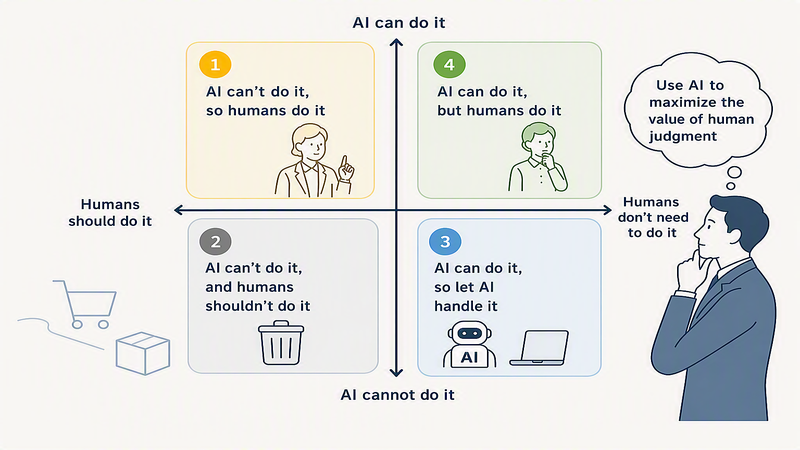
The conversation around "Ai in Procurement" is getting louder and louder!
The evolution of Ai technology, especially generative Ai, has been remarkable.
We’re seeing growing expectations that Ai can support all kinds of procurement activities— from search, information gathering, data analysis, and document creation to supplier evaluation and price analysis.
And of course, these technological advances open up huge possibilities for procurement teams.
At the same time, though, I sometimes feel that the conversation is becoming a little too focused on the technical question: “So, what can Ai actually do for procurement?”
Maybe it’s time to take a step back。
■Four Ways to Look at Procurement
What is the essence of our procurement work?
The question, “What can AI do?” naturally leads us back to a more fundamental question:
“What is the essence of what we do in procurement?”
Procurement is made up of many different types of work, all mixed together.
So, I tried organizing procurement activities from four different perspectives:
① "Ai can not do, and We can do" -> So, let us do
② "Ai can not do, and We don't want do" -> Then, stop these work.
③ "Ai can do, and We can not" -> So, let Ai handle.
④ "Ai can do, and We can do too" -> Well, let us drive.
Let's take a look at four perspectives into a simple 2×2 matrix.
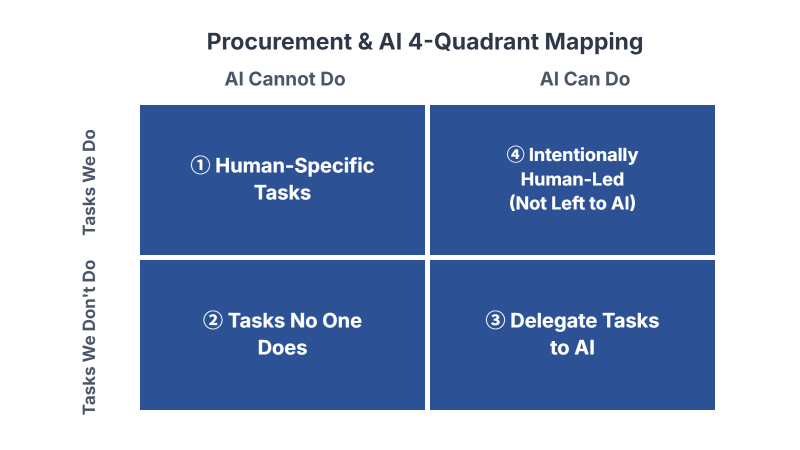
The really interesting one, I think, is ③.
And then there’s ②, which is probably the quadrant that could spark the most interesting brainstorming.
These are activities that Ai can’t do because they require something uniquely human. But at the same time, they may not actually create much value.
In that case, perhaps the answer should go to ②.
And this is where I think we need to go back to the very basics of how we think about procurement.
Take, for example, regular meetings with key suppliers involving executives or VPs.
AI obviously can’t do that.
A procurement organization that believes these meetings are essential would probably put the activity in ① —“AI can’t replace this, so let’s keep doing it.”
On the other hand, another procurement organization might say:
“Do we really need something that special? Let’s just have normal meetings and negotiations with all suppliers fairly, whenever necessary.”
That organization might put the activity in ②
And once you map your procurement activities using this matrix, I think it also becomes much easier to visualize where “Upcycle,” provided by A1A Inc., which I support, can create value in procurement.
But that is not the goal.
What we are aiming for is not simply to replace people’s work with Ai.
■Ai Is Not the Goal
The goal is to redesign procurement itself.
The other day, I read Haruaki Deguchi’s The World Can Be Understood Through Religion in one sitting.
One part that caught my attention was his discussion of Jewish religious laws and commandments.
Judaism has various religious rules intended to preserve the identity of the community—for example, rules about not working on the Sabbath, dietary regulations, and rules concerning marriage with non-Jews.
Of course, there is nothing inherently wrong with having rules.
Every community needs certain rules to protect its values and identity.
But over time, it can happen that following the rules themselves becomes more important than the original purpose behind those rules.
In other words, the question shifts from:
“Why does this rule exist?”
to:
“Are we following the rule correctly?”
Jesus is said to have challenged this way of thinking.
When he was criticized for healing a sick person on the Sabbath, he responded:
“The Sabbath was made for man, not man for the Sabbath.”
The goal is not to introduce Ai.
The goal is to use AI to redesign procurement itself.
Procurement and management consulting, advisory services
We offer a free 60-minute initial consultation.(OK to exceed)