
Apple’s iPhone Duo Sourcing Strategy: “AI” or “Human”?
 kenji.shinkai@global-sourcing-academy.com
Apple's iPhone holds a large share of the Japanese market, and TV commercials for the "Duo" have become a common sight lately.
The Duo's biggest draw is its foldable OLED display — genuinely captivating!
Media attention has focused on the fact that this Foldable OLED is sourced exclusively from Samsung.
Foldable OLED suppliers generally fall into three camps: Korean, Chinese, and Taiwanese (see diagram below).
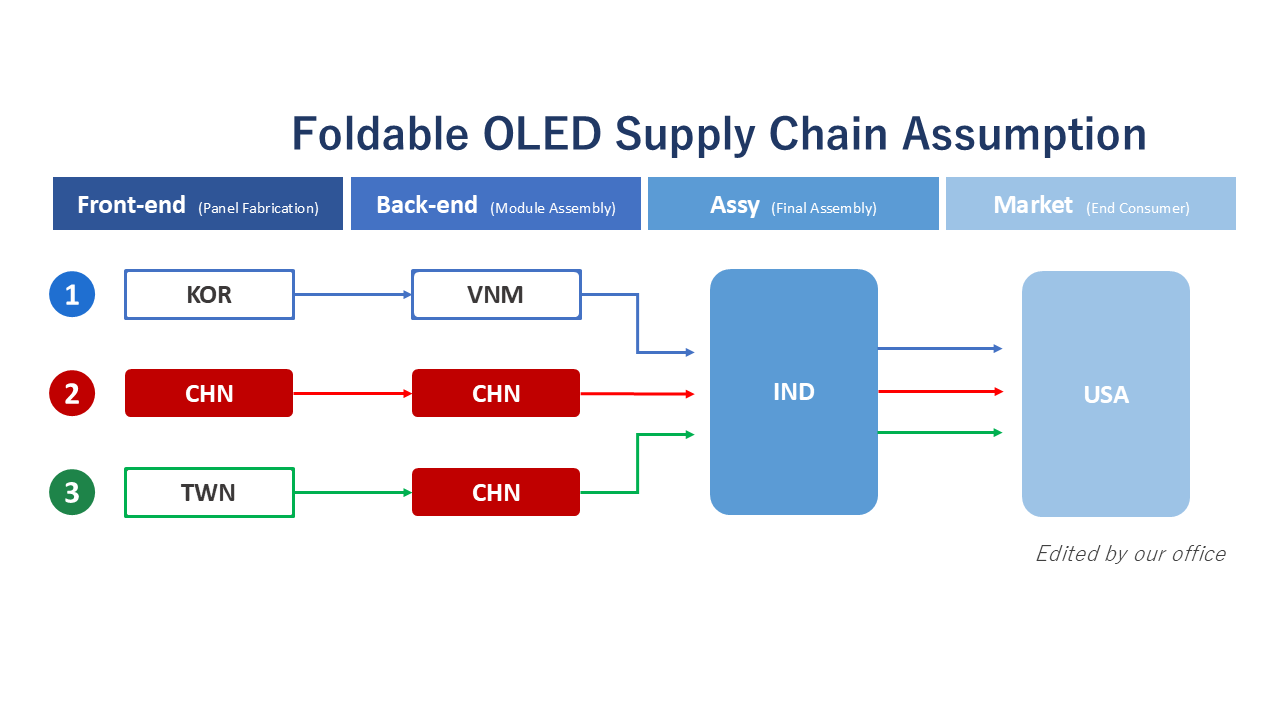
The usual supply-chain choke points discussed are "concentration" and "dependency on China" — hence why "multi-sourcing" and "China + 1" are classic strategies.
■Exclusive Supply Agreement
Three-year exclusive supply agreement
What caught my interest was the report of a "three-year exclusive supply agreement" between Apple and Samsung.
A typical supply agreement can run on a loose "gentlemen's agreement" basis without fixing all prices upfront (better still if sourced from multiple suppliers).
An "exclusive" agreement is different, though. Relying on a single supplier with a gentlemen's agreement could be too risky, so such deals are usually structured as binding contracts with obligations to supply and to purchase. Without price, the seller can't deliver — and since supply is exclusive, the buyer has no fallback if it doesn't. This is where price becomes critical.
■The Risk of Losing Competitive Pricing Pressure
Competitive Pressure.
A binding exclusive-supply arrangement come with a certain type of price agreement such as Fixed price, Annual revise, Update based on material cost move or exchange rates? Some pricing mechanism is usually needed.
If Apple and Samsung's agreement really does run three years, that roughly matches a smartphone's typical product cycle. It leads us no price competition for that period.
■Procurement Decision-Making
By AI? Or by Human?
Decision-making style are or were:
・1990s–2000s: "Experience," "Intuition," "Guts" , "Hunch" (?)
・2000s–2010s: Supplier evaluation via QCD + S + T
・2010s–present: Framework-based decisions (*)
Note (*) : Sourcing frameworks include TCO (Total Cost of Ownership), ROIC, and others.
TCO: It will give you an idea the highest/lowest total cost including risk
ROIC: This will tell us an Efficiency (or Utilization Rate) of our assets.
Optimal-Portfolio: It will tell you the optimal selection from scenario combination.
Multipul sourcing has both pros and cons. Portfolio theory, built on the premise of diversification, seeks the combination that minimizes loss while capturing returns.
"building up inventory", "increasing order volumes" or "diversifying suppliers" - We know what to do !!
The most important thing will be - "Sign", "Trigger" or "Indicators" that make procurement move those methods.
Step 1: Identify the Risk
Step 2: Countermeasures
Step 3: Generate "Sign", Create "Trigger" or Design "Indicators"
By the way - Was this sourcing decision made by "AI", in your opinion - or by a "human"?
I have a feeling it is Human-feeling decision.
Also This shows Apple's strong Determination or Will to make the Duo succeed no matter what, even with single-sourcing. I am here wishing the Duo every success.
Bringing in advice from outside experts or industry-savvy outsiders is one way to approach it.
Procurement and management consulting, advisory services
We offer a free 60-minute initial consultation.(OK to exceed)
