
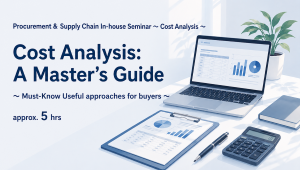
Seminar Overview
Learning the theory and methods of cost accounting, as well as other practical cost analysis techniques. Through hands-on Excel exercises covering three core methodologies — cost calculation, regression analysis, and financial statement utilization — participants will develop an end-to-end skill set
Do Any of These Challenges Sound Familiar ?
- Suspecting a supplier's price is too high, but lacking the data to challenge it
- Relying on guesswork and intuition rather than objective data to judge quotes
- Lacking alternative analytical approaches beyond standard cost accounting
- Struggling to connect a supplier's financial statements to their pricing
- Lacking confidence in cost negotiations with suppliers
- Finding cost accounting principles difficult to grasp
Skills Gained
- Knowledge: In-depth understanding of cost structures — material costs, machine rates, and labor rates — enabling logical interpretation of supplier quotations
- Analysis: Hands-on proficiency in three analytical methods — cost calculation, regression analysis, and financial statement analysis — ready to apply immediately in practice
- Tools: Practical fluency with provided templates: charge calculation sheets, cost analysis sheets, RFQ request forms, and more
- Foundation: The conceptual grounding and terminology required to advance to the Advanced Masterclass
■Information
Program
1. The Cost
- Cost vs. Price
- Cost-Based and Non-Cost-Based Principal
- Cost-Flow in Production
This chapter will provide a structured overview of the fundamental concept of “cost” in the manufacturing industry. We will also learn how costs of production are linked to a company’s profit and loss statement.
2. Price Quotation
- RFQ/RFQ and its contents
- RFx
- Quotation by Category
Some quotations from your suppliers contain detailed cost breakdowns while others do not. Why is there such a difference ?
In many cases, the level of detail depends on the type and characteristics of the purchased item.
This chapter organizes the trends in the content of quotations based on the type and characteristics of purchased items.
3. Basic Cost Analysis
- Matrix of Cost Analysis Approach
- Analysis by Cost Accounting
- Structure of Cost
- Material Cost
- How to calculate material costs
- Process Cost (Machine / Man Rate)
- Structure of Process Cost
- Machine Rate, Man Rate
- Points of Cost Reduction
In this chapter, we will learn and understand cost accounting approach. You will also learn the structure and theory behind cost calculation, as well as key practical perspectives for applying these concepts effectively in real business situations. We use Excel spreadsheets that contain embedded formulas.
?Quick Estimation of Rate
Exercise①: Material Cost Calculation
Exercise②: Equipment depreciation rate
Exercise③: Equipment repair rate
Exercise④: Man Rate
Exercise⑤: Process Cost Rate (Excel Template)
4. Statistical Analysis
- Statistical Analysis
- Cost Driver for Statistical Formular
We will use “approximation formulas” to examine the reasonableness of purchased item prices based on trend values. Let’s try together.
5. Analysis by Financial Statement
- Case 1 – if manufacturing cost report is available
- Case 2 – if manufacturing cost report is NOT available
That methods is very useful for “small business scale (small and medium-sized enterprises)” or for companies with a single business or product line.
Exercise⑦: if manufacturing cost report is available (Excel)
Exercise⑧: if manufacturing cost report is NOT available (Excel)
6. Cost Analysis to Cost Down
- Overview of Cost Analysis to Cost Down
It would be great if cost analysis were the sole means of cost reduction, but that's not the case. Let's organize an overview of the process from "analysis" to "cost reduction."
7. Closing
1. Q&A
Ex.1)How Japanese buyers challenges cost down compared to Western country's buyers ?
Ex.2)How Japanese suppliers are different from Western country's suppliers ?
?Takeaways
- RFI, RFQ Template(Word)✓
- Quotation Template(Excel)
- Charge Estimation Sheet(Excel)x2
- Cost Analysis Sheet(Excel)
- Useful Analysis Hacks(Excel)
- CVP Builder(Excel)
Details
Provided by
Kenji SHINKAI
Global Sourcing Academy & Office, Representative
Target Participants
- 3 - 5 years of experience in purchasing or supply chain.
- Procurement and purchasing professionals with a basic knowledge of cost analysis
- Team leaders and future management candidates
- Professionals seeking to improve their price evaluation and supplier negotiation skills through data-driven analysis
Place
Your office or Sites
Estimated Hours
Approx. 5 hours
Price
- Transportation expenses and accommodation costs (when travel requires an overnight stay), with lodging expenses limited to JPY 15,000 (excluding tax) per night.
- Course Fee (Excluding tax): JPY 37,000 per participant (If you feel that the course did not deliver the value you expected, we will refund the full course fee. Register with confidence)
How to Apply
We are happy to send you some samples. Please use the button on the right to contact us by email.